(1843)
Charles Dickens
Finished Reading: 12.2010
Read on the Nook
The classic story of mean old Scrooge and his hum-bug outlook on the merriment of Christmas. I've seen various film adaptations of course, and find that I knew many of the lines - which is awkward. A Muppet Christmas Carol, Mickey's Christmas Carol, etc. Without Statler and Waldorf or Scrooge McDuck, however, the real story is decidedly less comical and a little heavy on "grim," but that is as it should be.
Once again Dickens does not disappoint with his great descriptions of London and the colorful people who inhabit the cold, snow-covered bubonic streets. I noticed a few particularly fine longs lists of food, as well. No story is complete without a long list of fabulous foods.
A Christmas Carol is a very short work, just long enough to fully realize the depravity of Scrooge and allow him to make a turn-around before the ghosts get him. If it were any lengthier, I fear the story could not be completed in one Christmas Eve night and Scrooge might have the misfortune of enduring a few dozen more ghosts rather than only the famous Three: Past, Present and Future. (The Ghost of Past-Participle was luckily never written in).
In the end, Scrooge is of course redeemed and becomes the sort of guy I'd like to have for an uncle: he's got loads of cash, he likes to buy dinner for everyone, and thinks he can fly with ghosts. Sounds like a party.
Showing posts with label Fiction. Show all posts
Friday, December 31, 2010
Tuesday, June 1, 2010
Harry Potter and the Goblet of Fire
(2000)
J.K. Rowling
Finished Reading: 05.2010
This fourth episode of the Harry Potter saga feels superior to its predecessors in writing and plot. Having firmly established the characters of Hogwarts and the typical rhythms of the magical world in the first three books, the author seems now to expand the Harry Potter universe exponentially in many interesting directions beyond just Hogwarts and Harry's friends, bringing real villains into the light.
Rather than competing in the typical quidditch season, select students find themselves at the center of attention, competing for the TriWizard Cup. The national sport of the flying broom wielders is cast aside for an entire year, just for three days or so of watching their classmates compete at some exciting challenges. Why can't the witches and wizards keep up their favorite sport in between these events? If quidditch play is resumed next year, all the teams will be rusty from lack of practice. Maybe they have a spell for overcoming sitting on your bum all year?
The character of Mad-Eye Moody is particularly riveting, as he is more than an adequate replacement for the often vacant post of Defense Against the Dark Arts professor. Having experience with overcoming the dark arts himself, he is able to teach the students what they actually need to know. Too bad he doesn't end up quite right at the conclusion, but I hope he will return for some dark arts butt-kicking. Dumbledore seems to be gearing up for a stand against Voldemort and would be mad not to enlist the help of Moody.
There were so many things happening in this book that I can't even begin to comment on them all. Definitely the best Harry Potter book so far...
Tuesday, May 11, 2010
The Screwtape Letters
(1942)
C.S. Lewis
Finished Reading: 05.2010
This is written in a very creative format as a series of letters from one high ranking demon to a younger demon who is in training as a tormentor. (Or is the first lower ranked since Lewis describes Hell as using an upside-down system of lowerarchy rather than a hierarchy?) However organized, Screwtape is an experienced demon writing to Wormwood his inexperienced inflicter-in-training, imparting important knowledge to guide his young nephew at his task.
In the Screwtape Letters we see a human life from a demon's point of view, but don't get to know the particulars in any real detail, as we only read the responses to Wormwood's submitted progress reports to headquarters and so see a life lived third hand. This Hell-centric view of humanity reveals that there is a lot more going on than what we see, hear and think. Beyond each individual man, Lewis reveals a demon assigned to meticulous spiritual harassment, and beyond that is the whole realm of organized demon bureaucracy - each with assignments, reports and even celebratory banquet feasts to consume their conquests. The whole system is very muddy and dreary.
These demons attempt to draw man away from God (their Enemy) and their instructions and intentions are meant as the opposite to the Gospel, as Lewis shows us the other side of things. There is however, confusion as to the best way to achieve the intended results, as Wormwood is interested in tempting his man towards incredible evil, and the elder Screwtape is only interested in his pupil's success in turning his man away from their Enemy. Temptations come in many shapes.
Labels:
1940's,
British,
Fantasy,
Fiction,
Theology (Proper)
Saturday, May 8, 2010
Pride and Predjudice
(1813)
Jane Austen
Finished Reading: 05.2010
This most ancient of texts (1813!) is rather enjoyable for its captivating character development and as a compelling study of human behavior. Jane Austen escorts us through the life of an English country family with five daughters. Each member of the household is remarkably different from the others and it is a wonder they get on at all.
The times were very different two centuries years ago, when gentlemen of a certain social standing owned large estates and held honorable titles. Their days were passed visiting acquaintances, playing cards and sitting with the women, who knitted or sang and talked. Awkward silences were the norm. Every once and awhile a man of particular initiative might ask an eligible young woman, with whom he had spent the afternoon in the aforementioned awkward silence, to walk with him in the garden and, taking her hand, would ask for that very hand in marriage. Beautiful, well manicured gardens were made for moments such as these - it would seem.
Mr. Bennett, a country gentleman unlucky to have no male heir, lives in a comfortable house with the six women who are his wife and daughters, avoiding his cousins and neighbors who would someday inherit his estate. He finds comfort in observing the constant silliness of his family. His wife is absolutely ridiculous and frivolous in every way, and their youngest daughter Lydia is much the same. The oldest daughters, Jane and Elizabeth are the only sensible female creatures around, as the other two, Mary and Kitty are caught up in too many books and too many parties, respectively. The Bennett's ineffectual parenting has developed a troop of daughters ranging from too sensible to senseless and all unmarried.
I enjoy Mr. Bennett's subtle observation and the amusement he finds with his family and the visitors to Hertfordshire. He quietly recognizes the ridiculousness in most of them, which brings him a chuckle, and does not find serious people to be all too useful. He has a few witty lines for his wife and daughters, and after his youngest, Lydia, finds herself in some romantic trouble, tells his other daughters that they are now under a stricter watch. "And you are never to stir out of doors, till you can prove, that you have spent ten minutes of every day in a rational manner."
Elizabeth, much like her father and admittedly his favorite, shares his propensity for witty, thoughtful remarks. While dancing solemnly with Mr. Darcy she says, "We are each of an unsocial, taciturn disposition, unwilling to speak, unless we expect to say something that will amaze the whole room, and be handed down to posterity with all the eclat of a proverb."
Pride and Prejudice finds its structure in the socialization pattern outlined above, and its substance in the relationship that blossoms between Elizabeth and Mr. Darcy; he being a very rich, very eligible, and seemingly very disagreeable and prideful man. I don't understand Elizabeth's change of heart from hating Mr. Darcy to loving him. Their actions towards one another change from hateful resentment and prejudice to affectionate desire, but why? The change occurs over time, as Elizabeth gets to know Darcy's character more realistically, but I don't know how she ever gave him the chance in the first place.
Secondary to the major plot line is the dynamic duo of pompous Mr. Collins and his benefactress: the spectacle that is Lady Catherine de Bourgh. I could watch their condescending, haughty banter for many more chapters than we are given. These two co-exist nicely and share a common desire to be heard, respected and talk over anyone else who has an opinion. Very much the opposite are the characters of Mr. Bennett and his daughter Elizabeth, and I can only imagine the chuckle Mr. Bennett would have upon receiving the glory of Lady Catherine's presence should she come to visit, which he seemed always to avoid.
Being an old European story, I can't help comparing Austen's work to another old story or two. Though written later in the same century, which is quite enough time to separate any two things, the works of Leo Tolstoy allow for an interesting comparison between an English female author and a male Russian. Though Tolstoy was born about a decade after Austen died, I want to think some comparisons can be made between these giants of 19th Century literature, as War and Peace is to have taken place about the same time.
This being the only work of Austen I have read thus far, but being passingly familiar with her other works, I notice Pride and Prejudice lacks a the certain male-vision of the world evident in War and Peace and Anna Karenina. The setting is entirely domestic and from the female perspective (which is to be expected from a female author of this time). Soldiers are seen only at balls and parties, gardens and large tracts of green land are kept up by an army of unseen laborers, and gentlemen in general appear out of nowhere in carriages, drive up the front lane to call for supper, and disappear as quickly as they came to places unnamed and with business unknown. What do men do all day when they are not with the ladies?
While Austen's world is interesting in itself, and allows for a great deal of character and behavioral development within a very tight circle of habits oblivious to the outside world, Tolstoy presents a much more detailed and broader view of life and of course takes four or five times more pages to accomplish it. Politics, important cultural issues of the day, and a proper description of war are all missing from Austen's idyllic tale, but it is all appropriate as told from the point of view of the beautiful Elizabeth Bennett, and so we can turn to Tolstoy for the other side of things and enjoy Austen for what it is - just one important piece to the full understanding of 19th Century Britain.
Monday, April 26, 2010
Anna Karenina
(1877) Leo Tolstoy
Finished Reading: 04.2010
Tolstoy presents a wide landscape of characters and sets them divinely into these 870 pages. Anna Karenina along with the epic War and Peace reveals Tolstoy to be the master of describing regular people who do normal everyday things, simply living their lives and taking way too many pages to do it. We see both the grand ball at some magnificent estate where the young ladies are blushing for attention, ready to dance; as well as the open country and the farms where men hunt wild birds from the tall muddy grasses, surrounded by barking dogs.
Some characters are more at home in the elegant world of culture, and others feel most comfortable outdoors under the sun, although all find themselves adapting to new situations. The descriptions are rich and all personalities, thoughts, and intentions are finely related. Scenes are drawn with a finely sharpened pencil. We see the dew as it clings to the grass under a quickly rising sun, hear a distant herd of lowing cattle, and observe a clever observation - the "dilated nostrils" of a horse said to be "transparent as a bats wing." Along with the beautiful descriptions of nature, the interaction between characters is positively enjoyable.
While this book isn't really about anything in particular, that is, there is no particular quest or highly sought achievement, there are certainly prevalent themes. It is foremost a book about love, relationships, and marriage - quite broad, imprecise topics. The tales of various lovers are unfolded, and many of these associations cross paths. One relationship between timid admirers gathers momentum and blossoms, while another relationship between a weary pair fizzles out. Men are often looking around at the fine young women of society, and women wonder if they can trust any man, including their own husbands. Some couples have what it takes to make a successful marriage, and some do not. The scales are tipping in a precarious balance with the difference often being a little less forgiveness, communication or reconciliation than will keep a relationship steady.
Anna Arkadyevna Karenina is a troubled lover who at first is the very center of Russian society, calmly elegant as in the eye of the storm. She is torn between her husband (Alexei Alexandrovich Karenin) whom she does not love but with whom she shares a young son, and her lover (Alexei Kirillovich Vronsky) a younger man with whom she falls in love. Anna and Vronsky run away and are shunned by proper Russian society. Anna endures a painful change from respected woman above suspicion, talented in the consolation of other troubled women, to a disrespectful and selfish adulteress caught in a difficult tension between two men and the opposite sides of society they represent - official and outcast. Anna finds herself in a void, unable to receive love from either man, though they both claim her. Proper female virtue turns on its head for the whims of forbidden love and tragedy.
Konstantin Dmitrievitch Levin is a quiet man who prefers to keep others at arms distance, wanting much but having no real direction or life goals. He is a nobleman farmer who goes to great trouble with the best way to farm his land because it is easier than talking to people at parties or looking for a wife. He is unlucky in love and lacks the determination to remedy his heartache, but thanks to a lucky though impulsive decision, he finds a wife and begins a family. Not really knowing anything about family life, he fumbles through and keeps his heart in the right place, trying to love his wife Kitty. He rises from the gloom of bachelorhood to the happiness of excited love, and though it isn't always easy Levin makes a good life for himself.
"All happy families are alike; each unhappy family is unhappy in its own way." The novel begins with this line and reveals the primary theme of the book as the increasing happiness of one family and the decreasing happiness of some others.
The paths of these two central characters are on an inverse course throughout the book. As profiled above, Anna starts off as the center of Russian society, elegantly respected, a caring mother. Over time she becomes more and more self-centered, disrespected, and ceases to care for either of her children, one from each man. She is swindled by lust and crushed by her break from society. She becomes impulsive and confused, finding it difficult to make decisions and blames Vronsky and everyone else for her misfortunes. Anna is boldly defiant of any wrong on her part and does not seek answers beyond herself until the very end, choosing an unconventional method of conflict resolution.
Conversely, Levin begins detached and confused. He doesn't really know what he wants but after he marries Kitty he begins to find a comfortable place in proper society, participates in local politics, commerce and discussion; and gains a strong self-respect. He becomes a fuller person and even seeks truth beyond himself, finding solace in religion. His struggle with God allows him to love other people and a significant difference in the Levin's relationship is that their attempts to communicate and understand one another draw them closer, whereas Anna and Vronsky lack the ability to communicate and thus push further apart in their own selfishness.
Besides this compelling pair of opposites (Anna and Levin) who barely meet face to face but share a common extended family and a segment of society, I enjoyed Tolstoy's use of character conversations to create an interesting dialogue of the political and societal issues of late 19th Century Russia. The people of the day were interested in the best way to farm land, the importance of new farming machinery, the status of former serfs now working as low-wage laborers, the accepted status of an adulterous married woman, the importance of contributing to another man's foreign war, the favored styles of art, and even the best way to make jam - with water or without.
Friday, March 12, 2010
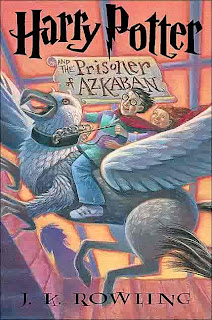
Harry Potter and the Prisoner of Azkaban
J.K. Rowling
Finished Reading: 02.2010
Sigh. I really don't know what to write about Harry Potter anymore. This book is very good, just as the others are very good. Each one might actually be getting better, but there isn't anything very deep to comment on, though I was thoroughly entertained. You might even call the book gripping, really. I could comment on the characters, but we know the main ones pretty well by now, and I don't have much more to say about an old rat that turns into a greasy little man, a black dog that turns into your uncle, or a deer that stares annoyingly at you from across a lake - except, cool. Very cool. You get 'em Harry.
I like secret underground tunnels and mysterious treasure maps with disappearing ink. The Marauder's Map is like Google Latitude, except on parchment. It took the muggles ten years to figure that one out for themselves. The big question now, leading up to the next book, is who will be the new Defense Against the Dark Arts teacher? Of course, you knew that would be an issue. Now if only I could gaze at the Marauder's Map to see him approaching...
Saturday, January 30, 2010
Harry Potter and the Chamber of Secrets
J.K. Rowling
Finished Reading: 01.2010
Let me take a moment to reflect on Moaning Myrtle and Nearly Headless Nick, two ghosts who roam around Hogwarts (independently), interacting with the students. I figure they might not get much reflection for themselves these days. (Not sure how ghosts actually work). What is more appropriate and Emo than a dead teenage girl haunting a certain toilet stall in the second floor lavatory of a dank old school, crying her eyes out, sobbing and moaning simply because she is a ghost? Talk about stage fright. She probably had skin problems, and that stall is probably covered in boy-band stickers. And then there is Sir Nicholas de Mimsey-Porpington, who died many centuries ago but escaped total separation of his head from his body due to an unfortunately dull axe incident, coming so close to being headless but now remaining nearly so. Very tragic. Let us not aspire to his fate.
I don't blame the young witches at Hogwarts for staying away from Myrtle's stall, but she is a lot better to unexpectedly run into during a mad dash for a quick tinkle between Herbology and Defense Against the Dark Arts than if you were about to drop your trousers and hear Nearly Headless Nick floating over from the next urinal, droning on about proper blade sharpening techniques. I don't think we cry in the bathroom enough.
Speaking of which, I wonder how the owls get on? After flying from London to Swindon, back to Hogwarts, back to London, and on to other places where the mail must be delivered, the owls have to return to their wee wooden cages in the dorms, with tired wings and what... some hay to sleep on?. Does Harry really keep Hedwig in a cage all night until he needs to send another message to ... oh wait, he doesn't have any other friends. Poor Hedwig. And does Errol just languish in his prison for weeks on end? We know teenage boys don't want to talk to their mother's very often, but this sounds like cruel slavery to me. I hope there is some sort of magic chamber that we don't know about, where owls can relax and shoots some billiards while off-duty. Maybe read the latest hoots or drink a brew. Of course, sparrows would probably deliver their messages, which is another issue for the unions.
Sunday, January 10, 2010
The Curious Incident of the Dog in the Night-time
Mark Haddon
Finished Reading: 12.2009
Autism is a disorder of neural development that is characterized by impaired social interaction and communication, and by restrictive and repetitive behavior. -Wikipedia
That is about as much as I knew before reading this fictional narration by a 15 year old autistic boy named Christopher (assumed to have Asperger syndrome). The boy discovers that his neighbor's dog Wellington has been murdered and he sets out to discover the reasons and who is the killer. In his murder mystery adventure, we are inserted into a mind that sees the world very differently than most people. Often autistic people are perceived in certain ways, perhaps as unable to comprehend ideas and what others are trying to say, but here we see from Christopher's own point of view that his world really does make the most sense and everyone else is absolutely incomprehensible.
Christopher lives in England with his father on an ordinary suburban street, and has a very ordered life, maintaining an unchanging daily schedule. He lives in the details that most people ignore, not understanding vague concepts and implied meanings. He doesn't like metaphors because they don't mean anything, and are not at all like the thing they are supposed to be like. He insists that the furniture in a room not be moved, or he will be afraid of the new uncertainty. He doesn't want to be touched by anyone, and avoids eye contact. For the most part, he only talks to his father and his teacher, and definitely not to strangers. Additionally, he has a photographic memory, remembering everything like it is playback on a tape, and loves science and logic. He has superior skills in mathematics, scoring well above his age group on tests.
Christopher has named the chapters of the book by prime numbers rather than the usual counting numbers, because it is more interesting. Thus, in this 226 page book there is a Chapter 233, though there is no Chapter 1 or 4.
Given his difficulty in understanding the world around him, his purposeful investigation of the dog's death leads Christopher to learn more about himself through new interactions with neighbors and new visits to places he has never been to before. He finds himself overloaded with information (since he notices every detail and remembers every detail) and has difficulty continuing his investigation as new details surface. Continually, he comes across adults who do not understand him and don't know how to communicate properly with a boy who doesn't speak or socialize in the way they are accustom to. If they would only take the time to listen to him, rather than quickly deciding he is loony and walking away, a lot of pain and misunderstanding could be avoided.
The boy's view of the world is much simpler than my own view; mine being clouded by occasional grand illusion. I feel this book is a clearer lens for things I've looked at for years and yet have never really seen. Often things really are as simple as they appear, and a unknown explanation may not exist. Even my frequent use of the word things in this very paragraph would not be tolerated by Christopher, as he would like to know more detail about what these vauge things are, which makes for better writing anyway. I will now try to assume less, notice more, and hopefully better understand people like Christopher who are not dumber than the rest of us, only a little different.
Wednesday, December 30, 2009
Harry Potter and the Sorcerer's Stone
J.K. Rowling
Finished Reading: 12.2009
Largely hailed as the greatest thing going these days in children's literature, I can't confirm that the Harry Potter series lives up to the hype because this is the first volume I have read, and I have not recently read any other children's literature for comparison. The book is accessible to adults as well as children, which does make it rise above other kids stuff (theoretically, as far as I know) but it is hard to comment on a highly promoted extravaganza, for I am looking into it for too much.
This is all said, but not to say I do not like the book. Only that I know too much about it going in, for I have seen the films and by virtue of simply being alive, it isn't new to me. The suspense and surprise is gone (which I greatly enjoy in a book). A positive note on having seen the movies first is that I do approve of the pre-existing images formed in my head for each character and event, as they were appropriately created on film to reflect the book.
I like that the character names are not the regular names of the people I know, and I like the characters themselves, and the way they interact. Having all this wizardness happen in the midst of our real world is intriguing, which I enjoy more than if it had been in a separate dimension. Sometimes I forget these are just kids, as the dialogue is a lot more engaging than what was ever said in my childhood. Truthfully though, I am not really into witches and wizards, maybe preferring sagas where magic happens a little on the side (Gandalf in The Lord of the Rings) to the whole concept of a school for young wizards. But I will give it a try and read books two through seven.
The peripheral things fascinate me the most, like having the mail delivered by owls. That makes me laugh.
Sunday, November 15, 2009
War and Peace
(1869) Leo Tolstoy
Finished Reading: 11.2009
The epic tale of Eastern European aristocratic life begins amidst some rich Russians attending splendid parties, speaking highly of the grand shadow cast by Napoleon upon the continent as he fights his distant war against nations unconcerned for here. Their domestic life seems distant from the death blows on the battlefield, it being but a romantic notion to be toasted. Finally, and alas, the war knocks on the doors of Moscow, burning with total destruction the solitary stability until now ubiquitously known. For many years these evil clouds hide the bright prospects of the future, but miserable deaths are followed by joyful births, and life goes on again with the cyclical yearning for adventure in youth, the steady hard work and simplicity of adulthood, and the remembrances of other times now forgotten.
Equal parts high society dinner parties and muddy field trench poker games, the contrast in the stations of life is exceptionally poignant. During one battle between the Russians and the French, a Russian commander retreats and pulls his remaining troops back to safety. To those who had only heard of the battle back home, the word heard was of a glorious Russian victory over the cowering French. In reality, this particular Russian commander had sent a messenger to bring word of victory to his superiors as he retreated to safety. He hoped to be given a promotion to Commander-In-Chief, in charge of all fighting in that region, on account of his assumed great victory. However, there is another inconvenient commander who outranks him, and so he leads his whole regiment around the countryside, their goal over the next few days being to hide from the ranking commander until this commander's promotion can be received. Napoleon is seen only as sub-plot while the legitimate Russian commander acts as enemy to these troops. During the confusion the soldiers are starving and fall to looting and marauding the local towns. The reported glorious victory is actually a sham, as the Russian army is on the verge of shooting itself. Meanwhile at home, the aristocrats celebrate the glorious victory against the French, and beautiful young ladies smile as they dance with their admirers in the ballroom, hoping to impress a gentleman or a soldier with an aim to improve their family's social standing with a fashionable and wealthy marriage.
I enjoyed the last chapters when Napoleon has gone home where it is warmer, leaving cold Russia to itself and the families whom we've followed throughout the story, having been ravaged by war and despair, are now living well enough as a loving family, entrenched in the happy business of domesticity. A little girl sits with her father to hear a story, a wife talks about her day to her husband who barely pays attention, and the servants take extra pride in their service to their beloved masters for everyone is happy. The atrocities of war are forgotten for now, as life goes on in the brief few breathes one can take before stumbling again into war. But those battles will not be fought by this aging generation, for they have already fought and died their deaths. The young ones who gaze out of foggy windows wondering what lies beyond, they will one day learn to fight. They do not know that beyond this peace there will be more war, followed by peace again, for they remain still on this side of the pane. War and Peace and War and Peace and Such.
This example of historical fiction is captivating. We often wonder what happened at some great event beyond the often repeated and remembered moments in books and movies. How was Napoleon feeling before he gave the orders to attack in a certain battle? Was he tired or worried about his hair? Had he a disagreement with one of his generals or perhaps he had just finished a delicious meal of crepes? We don't really ever know, but historical fiction allows pretending within the framework of fact. Not only could these events be true, but they very well might be for all we know which is often more exciting than the truth anyway, though in this case much longer to get through.
As for this novel being the greatest ever written (as has been supposed by some), I cannot attach such a prestigious medal to the lapel of any book, but certainly War and Peace is standing somewhere close, taking up half the room.
Saturday, August 15, 2009
The Silmarillion
J.R.R. Tolkien
Finished Reading: 08.2009
Being the tale of the entire history of Middle Earth, this narration is painted with broad and lofty strokes. Great expeditions across many leagues of map are described, but how the journeyers camped out or what they ate in the evenings is not within the scope of writing. The places where dwelt many men and elves are often described only as places with singular emotion, such as "The people seemed happy there." Little if anything is said of the architecture of these places outside a few off-hand mentions of great towers, great halls or terrible pits within which you would not want to find yourself. Many a battle is fought on mighty hills and lasted for many long weary days but might be described only as such:
"And there was a great battle and many elves and dwarves were slain."
However, a few times we trip over a node on the Timeline of Middle Earth, and stumble into an interesting situation involving the people and places we find in that age. The glue that holds many disparate stories together is the story of the Silmarils. The Silmarils are three very rare and precious jewels mysteriously created by the Noldorian Elf Feanor, within which is contained the radiance of pure light - the original light of the Two Trees and older are they than even the sun. So sought after are these, that they cause many wars to be fought between good and evil and even wars between good and good (kin-strife or worse). The dark lord Morgoth is ever seeking them and often possesses all three, having their beauty for a time set in his iron crown. Kings are murdered, loves are lost, and greed conquers all. The radiance of the past is increasingly diminished by progressing shadows as evil besets all who desire the infinitely worthy and irreplaceable Silmarils.
A most fascinating aspect of the Silmarillion is that it tells us more of the early origins of the beloved characters from The Lord of the Rings. Did you know that Galadrial is Elrond's mother-in-law? She is also his great great aunt on his father's side. Elrond's great great grandmother was a divine Maia from the original creation of the world, and his great grandfather was a mortal man with only one hand named Beren. Crazy Elrond.
A particularly exciting story tells of when Beren stole a Silmaril from the crown of Morgoth and as his hand was clenched around the sacred jewel, that hand and the jewel were bitten off by a fell beast. Later, the beast was hunted down and destroyed and upon slicing open its belly, there was found within the still clenched hand of Beren and within his grasp the Silmaril, which was regained.
Another important tale is the condensed version of the journeys of Turin son of Hurin, as appears in full in The Children of Hurin. Turin accidentally marries his sister and she becomes pregnant. Neither knows the other is kin, but after slaying a mighty dragon Turin has to deal with his family issues. Upon learning of her fate from the mouth of that very dragon, the sister-wife hurls herself off a mighty cliff and falls to her perilous end. Turin takes his sword and falls upon it, and evil prevails in the land.
An additional interesting story is the Creation of the World, which began by thoughts and singing. The music becomes reality and is then lived out by the creatures of the earth.
Also told is the tale of how Sauron went from run-of-the-mill bad guy to all powerful flaming eyeball in his tall tower. He was a sort of grand vizier to a king of men, and then established his own kingdom before losing his physical body in the drowning deluge of the entire western half of Middle Earth. I'm not surprised he resorted to the safety of a tall tower from which he could keep unblinking watch for further bad weather, rising seas, and newly drawn maps of Middle Earth.
In the end, the whole of The Lord of the Rings, told elsewhere in three volumes and about 1200 pages, is summarized in the last two pages of this book. A lot happens in between those two pages, but that is another story.
Thursday, July 30, 2009
The Hobbit
(1937)
J.R.R. Tolkien
Finished Reading: 07.2009
A difficulty arises in writing about fiction, for I am torn between keeping hidden the great mysteries of plot and facts (that is to say not ruining the ending) and just telling you all the juicy details so I have something quite great to describe. You inevitably read on and are confused, perhaps uninterested in such nondescript drivel, or conversely you throw down your laptop because I have given you some hidden knowledge which burns your eyes before its time, stinging your anticipation with revelation. It is like me telling you all about my exciting trip to a certain place; where there were changes in elevation, the passage of time, maybe a little growth of my beard, and certainly some dialog which I was a part of. But if I don't tell you where I went, how long it took to get there, what brand of razor I used and how many times I cut myself using it, not to mention what choice words were overheard in certain places that serve certain beverages, you would then have both not read the book and not had a reliable description of my reading the book. You would have only heard that I had read the book, and you might suspect I think myself better than you for having done so. After all, I haven't written a single word about the Hobbit so far, and here we are moving right on to paragraph two, not nearly soon enough and finding ourselves slightly below this fabulous green dust jacket. Fantastic.
Bilbo goes there and comes back again indeed, but where does he go? There. And Back. Again. Actually just once. You see, we know hobbits well from our reading The Lord of the Rings, in which Bilbo certainly plays a part. Hobbits hate to do any exciting things at all but seem to do a great many exciting things anyway, and always with the best of company. At least the ones that get books and songs written about them. This is the adventure to begin such adventures and it ends well for the Bilbo, Gandalf and some others that we care the most about.
There is a lot of talk about beards for sure, and certain things are said about the length of them (in general regarding the hope for further growth and the avoidance of witherance on a fellow dwarf as a customary greeting) but really beards have little to do with anything here or there.
We might as well judge the book by its cover, since this one is so nice. Observing it, I suspect that some mountains are climbed or at least passed by, some trees are present in large bits of forest, and that the eagles are coming (or going). The sun balances dangerously on that far peak towards the middle, hoping you won't notice him, so I would guess the eagles are leaving that sort of thing. One shouldn't mess with the sun when he is in a mood to balance on something so cold as a snow capped mountain. If something were to go wrong, we would not be able to see Bilbo as he journeys back from there, and he might not even make it at all given the darkness and cold that would certainly follow. One thing is certain, and that is that I cannot read in the dark, and you are not sure whether I read this book at all.
Saturday, July 11, 2009
The Children of Hurin
J.R.R. Tolkien
Finished Reading: 07.2009
Tolkien began writing what would become The Children of Hurin many years before he wrote the epic Lord of the Rings. However, he never finished this bleak story set in the First Age of Middle-Earth, though he apparently worked on it from time to time. His son Christopher Tolkien has published the story from various gathered fragments and drafts discovered over the years to bring us the story of Turin son of Hurin, with the best intentions towards maintaining the original voice of his father.
While yet a boy, Turin is separated from his family and grows up in a royal household of elves. But darkness reaches across the land, and evil destroys all that was once good, near and far from home. When Turin becomes a man he leaves his adopted home and wanders Middle-Earth to seek his family, joining with outlaws, elvish folk, and dwarves along the way. He valiantly slays orcs and dragons with his mighty sword Anglachel, but it is at the eventual reunion with one of his family that he finally pulls the darkness down upon himself. We discover Turin's fatal blunder long before he does, and we can't help but watch the tragedy unfold with anticipation. There are no hobbits to misdirect our attentions.
Beginning rather slowly with histories and long narrations, the story finally gets underway with vivid description of epic battles and bloody deaths. Dragon slaying is particularly exciting, as are the romantic implications discovered in a wrongful love, downwind to the unraveling of tragedy. The Children of Hurin is a much shorter story than The Lord of the Rings, containing less detail, and relying on story movement and action without tangential chapters devoted to further develop characters. Particularly in the last few chapters, the the characters are very convincing, and the writing is superbly crafted. Though not directly linked to one another, the two stories are a complement, as they share the same fictional universe.
Joyfully, an index of names is provided at the end of the book. Turin, Morwen, Mablung, Glaurung, and Finduilas are some of the many names thrown at us, if you can remember who belongs to which.
Tuesday, July 7, 2009
The Children Of Men
P.D. James
Finished Reading: 06.2009
It is the distant future, the year 2021: humanity is unable to sexually reproduce and the population of the world dwindles after a sudden mass infertility pandemic. Many lose hope and kill themselves but most live on in sorrow. Children slowly grow up, but no new children follow them into adulthood. England prepares for difficult times by moving the dwindling masses to selected urban centers where provisions can be more easily administered. Zero tolerance for crime sees offenders high and marginal shipped off to an island where they are out of sight but not out of mind. The tears of the approaching cessation of humanity are tremendous.
Britain faces this daunting storm under the leadership of unemotional Xan Lyppiatt, elected to govern as the Warden of England, but now rules as a dictator. He and a small council oversee an apathetic nation that cares little for democracy and desires only to be free of pain and boredom.
Xan is
a dumb name. How do you pronounce Xan? If I ever write a novel about the future, the distance future mind you, I hope to remember to use names much easier on the ears. This name makes me very uncomfortable and sad.Additionally, I never felt at ease with the main character, Theo Farron, a cousin of Xan. He seems distant from the reader, as do all of the characters. Unfortunately, these people are not well developed outside of their moment; that is, I can't imagine them doing anything at all outside the very page on which I read them, as if they are afraid to look over the edge of the page to find there some mention that all humans are dead.
All is not lost, however, as there are twists and turns to keep me interested enough in the small group of resistors who try to evade the authority of the State-run system to prepare for the End of Days, lead by Theo. When things seem darkest, hope is kindled when a woman mysteriously becomes pregnant. How this happens is not addressed, but by whom is revealed. A reason is not given for the original mass infertility, ominously called the Omega. Within the story, some speculate that this birth could mean the beginning of a time when women all over the world will again give birth to children, while some are of the opinion that this is an isolated incident. Either way, this moment of hope is known as the Alpha.
The most interestingly described scene is when Theo stops to enter the home of an elderly couple as he leaves town, being pursued by government police. He ties up the old man and the old woman that he finds there and takes the provisions that he and his waiting comrades need. One of those waiting for him is the pregnant woman. He takes sheets from the closet and food from the kitchen but being not a very violent man, Theo is overly careful with the old couple, allowing them drinks of water and a trip to the bathroom before he leaves them tied up and lying on their sides on a small bed. He repeatedly checks to makes sure that they are alright and learns the time at which the house cleaner will be coming the next day to find them so that he doesn't worry. It is excruciating to see him continue to waste time with them in this way while the police are on their way and could knock down the door at any moment. The pregnant woman is waiting as well as Theo stumbles into the role of reluctant burglar. This is ultimately the most tenuous situation in the book and contains more suspense than an unsatisfying ending that I won't justify with comment.
Wednesday, June 24, 2009
The Great Gatsby
(1925)F. Scott Fitzgerald
Finished Reading: 06.2009
Jay Gatsby is in love with a married woman named Daisy. Her husband Tom has a mistress named Myrtle. She, in turn has a fool of a husband named George. But Gatsby is no fool, only a man in love, and that circle comes back to him in a bad way.
So as to not ruin the plot, I'll skip to the end and make my point. Gatsby is gone and no one cares about him in the least. Dust to dust, and all. His memory is forgotten by all those who thought him so great due to his great accumulation of wealth. His possessions now sit quietly in an empty mansion and are now meaningless to those who would use him only as a means for access to his things.
Wednesday, June 10, 2009
The Return Of The King
(1955)
J.R.R. TolkienFinished Reading: 06.2009
Sauron, the unpopular and non-elected dictator of Middle Earth is defeated when the hobbits Frodo and Sam sneak past the Orc Party of Mordor and carry the Ring of Power at last to a dark cave deep within Mount Doom. There, Gollum and Frodo struggle on a treacherous cliff to possess the ring for their own before the former falls to his death clutching his precious and one of Frodo's fingers with it, for the finger could not let go. Just as Sauron lost a finger in a similar struggle of old when the ring was first taken from him by Isuldor, Frodo is parted with the Ring of Power only at the struggling desire of another. All attempts to take the ring by force end in doom. Gollum falls into the bowels of Middle Earth where both he and the ring are gloriously un-made.
At this event, Sauron is destroyed in the tower of Barad-Dur, which is where he is hiding. The Eye is extinguished. I have trouble with this ending, as throughout the Lord of the Rings series, Sauron (the name-sake of the books) is not encountered in the first person or bodily except as a footnote of ancient lore. The Dark Lord remains in the Dark Tower gazing about Middle Earth with his Fiery Eye Telescope, trying to see what he can see, as he bides his time and gains strength for his final war to defeat all that oppose him. Somehow he didn't see this coming. Not so scary now, are you? He meets his end remotely, afar off in a tall tower and does not get to fight his foes face to face, rather he relies on armies of Orcs and evil mercenaries to do his fighting for him.
Perhaps Sauron was not fully transfigured to his former glory, and these events of the War of the Ring came to pass too early for his liking. If given more time, would Sauron have descended from his tower to march across Middle Earth among his legions of soldiers? Would he have ten fingers or nine? Is his power not now in physical strength but only in the mental persuasion of the weak towards his will?
According to ancient lore, Sauron was parted from the Ring (along with his favorite finger) on a battlefield, so he once had a physical presence and the ability to battle. What would Frodo have encountered had he made for the Dark Tower instead of Mount Doom? If Frodo used the ring for his own rather than destroying it in the fire as instructed by Gandalf, would he have had to battle with Sauron, head to head (or head to eye)? Ring Bearer vs. Ring Maker?
All I'm saying is that Sauron is a wimp for not coming down from his high tower. He is defeated by a mear Hobbit eyelash.
Thursday, May 21, 2009
The Two Towers
The Lord Of The Rings(1954)
J.R.R. Tolkien
Finished Reading: 05.2009
So many plot lines and seemingly unrelated adventures populate this volume that I cannot begin to comment on the whole of them. There are more great tales told within than would seem to fit between two covers . Thrust into action and left gasping in suspense at the end, the reader of the Two Towers notices it to be better written than its predecessor volume; describing great battles, dangerous treks through high mountain passes, and hairy encounters with an unimaginable variety of foes. The stench of defeat is common in the nose and darkness looms far across Middle-Earth. Hope is but a four letter word that isn't even on the ballot.
One storyline follows Treebeard the Ent, he of the ancient humanoid/treenoid race, older than any other creatures that exist this day in Middle-Earth. Treebeard and his gang of tall, slow-moving, slow-talking tree-like creatures, are very wise and have lived peacefully throughout the long centuries in the stuffy Forest of Fangorn, mostly just standing around like trees do. Treebeard lives a solitary life, but one day meets the hobbits Merry and Pippen who have wandered into the forest to escape deadly pursuit by Orcs. Treebeard is angered into fighting an epic battle with Saruman because that dark lord has cut down his precious trees. Orcs and their sharp axes are not looked kindly upon by quiet Ent eyes. Chuckling, I am reminded of the Lorax, who "speaks for the trees!" in Dr. Seuss' The Lorax, but that is another matter save their matching awesome mustaches.
While Treebeard might welcome the Lorax into his gang, he has companions with such names as Skinbark and Quickbeam, also ancient Ents. Along with the very forest itself, the strong Ents stride into Isengard and destroy the city by ripping it apart block by block. Every evil in it is driven out save the dark tower of Saruman which stands amongst the rubble in the now still waters from the dam that was broken. Saruman looks down panicing and seems rather feeble, having been beaten up by a bunch of trees and all.
It takes a very long time to say anything worth saying, and we do not say anything unless it takes a very long time to say, and to listen to. Do not be hasty.
Wednesday, April 29, 2009
The Fellowship Of The Ring
The Lord Of The Rings(1954)
J.R.R. Tolkien
Finished Reading: 04.2009
The first of the highly epic fantasy trilogy, I am watching the corresponding movie adaptations after reading each book. Admittedly, this is my first time reading the series, though I had seen the movies when first released eight, seven and six years ago, so Elijah Wood and Ian McKellen are Frodo and Gandalf for me, and there isn't anything I can do about it and that fiery red eye is watching at me.
If a plot summary is even appropriate, it would start by stating that Frodo Baggins is a wee hobbit with big feet, a gentle half-sized creature resembling a human, living in a land of round doors in earthen homes, a place called the Shire. He comes to be in possession of a simple gold ring with cryptic markings revealed only by fire, the bearer of which wields great and horrible power while wearing the ring on his finger. It also makes him disappear, which is scary for both he and those around him. Frodo must journey to the place where the ring was made, for only there can it be destroyed - the dark land of Mordor. Along his journey he has the help of various friends of different sorts: men, wizards, elves, dwarfs, hobbits and female elves too. Together they form the Fellowship of the Ring (well, not the female elves), the likes of which has never been seen. Their quest is great and dangerous as they travel through beautiful mountainous lands and majestic cities, meeting foes and friends along the way to the ominous Mount Doom (scary drums in the distance).
Tolkien has created a high descriptive, highly involved world with its own creatures, languages, fonts and even a fold-out map which is glued to the back cover as a guide for the reader. The third book (to be reviewed later) contains appendices and indexes on the background and history of the characters and creatures we encounter in the story. The comprehensiveness is enormous.
The Fellowship of the Ring starts us in the lands from which the main characters come from. Frodo and the hobbits are of the Shire, and it is here that the story unfolds, in the middle of an 111th (elevendy-first) birthday party, of all things. Along the way we pass through glimmering Rivendell and shimmering Lothlorien, home to the beautiful elves and their girly blond hair; and then through the dark mines of Moria, home to the hearty dwarfs and their scraggly beards. The evil forces are largely unknown to most of the Fellowship at this point, though they encounter the persistent and sinister black riders and herds upon herds of disgusting orcs waving swords and shooting arrows. Sauron's fiery eye is watching, and Saruman is looming in lands unknown.
My favorite character is Gandolf the grey, an old wizard and the primary guide to Frodo. He is very wise and wields magical powers, but he seems to hold back and is unsure of his abilities, appearing not to be as powerful as one might think a wizard should be, which keeps him mysterious. He is thoughtful and caring, loving and good. He sacrifices himself to save the others from the Balrog, a beast evil enough to finally test Gandolf's powers in the shortest epic battle sequence that I have ever seen, though it takes place on a grand stone arch bridge hewed from the very living stone. He is cast into the darkness of the fiery underground pit, and there is much sorrow, but the story continues with two more volumes!
Sunday, March 8, 2009
Oliver Twist
(1838)
Charles Dickens
Finished Reading: 02.2009
"Please sir, I want some more."
This innocent statement from poor little Oliver, a misunderstood and helpless young orphan, leads to his banishment from the charity poor house, where he is seen as an ungrateful troublemaker. He must now go elsewhere to receive his meals.
This is the first story of Dickens' that I have read, and I am thoroughly hooked on his wit, humor and clever description. It may be supposed that something written during the days of US President Martin Van Buren (who?) and the early days of Queen Victoria of England (after whom many old houses are named) would contain pages of fluff and might perhaps be printed on intricate white doilies for all I know.
But Charles Dickens shows us the real London of his day, the gritty part swept under the rug in our history books. Populated by curious characters, Oliver Twist takes us through the crowded and filthy cities where the poor pass their days, either slowly dying in the work houses or quickly dying on the streets, if they are not cunning enough to learn to steal, or fortunate enough to be offered a hand.
Oliver is always at the mercy of others, being quite helpless himself, blowing with the winds of fate. Whether falling prey to the sneaky and manipulative hands of street crooks such as the Artful Dodger and Fagin the Jew, who draft him into their shady dealings; or whether he is cared for with the kind embraces of wealthy Mr. Brownlow and sweet Ms. Maylie, Oliver seems to be pushed back and forth between the camps of good and evil, stumbling in the darkness over the line that separates these worlds. Even at the outset where the famous hungry quote is uttered, Oliver was chosen by lot to ask for more dinner at the poor house meal hall, pushed to his reluctant rebellion by the other hungry boys.
Many themes could be explored from this story, but I am intrigued by the idea of the young boy at odds with the world, who is in need of some grace just to live. Oliver is not able to work hard enough to escape his helpless situation of hunger and poverty, as he is just a boy, and would have been dealt neatly into the hands of the lowest society if not for a few kind hearted people with whom Oliver has more in common with than he could imagine at first.
The characters are richly described and I can imagine myself amongst the street characters who seem very real and who give life to the blocks and blocks of city filled with similar stories to the one told in these pages. Even an old tale can entertain today, for the characters of life don't really change...the hungry still want some more, and the rich often don't hear it.
Tuesday, February 10, 2009
The Great Divorce
(1945)C.S. Lewis
Finished Reading: 02.2009
In this creative story depicting the great separation between heaven and hell, the divide between God and sinners, Lewis explores the idea of the "Refrigerium," or holiday from hell. I was not familiar with this term before reading the book, but apparently it is said that those in hell are given a chance to leave for a short time, mostly choosing to visit Earth and appearing as ghosts or various haunting apparitions. The Great Divorce begins with a group of regular people waiting at a bus stop in hell. Upon boarding the bus, which is magical and flies, the passengers are taken up into heaven where most are incredibly scared out of their minds, and only a few wish to stay. Those that want no part of heaven hurry back to the bus for the return trip to hell.
In hell, it is always raining and twilight, with the darkness ever looming. The unnamed narrator boards the bus and we follow him on his journey to heaven. Before he arrives, he meets a few people on the bus with whom he has short conversations. One man explains how the grey town that they just left is so bland and horrible because people quarrel with one another which leads them to move away from their disagreeable neighbors. Each quarreler moves his home further and further away, with no one ever moving any closer to where they started, and so the whole town is a sprawl that goes on for millions of miles. This sounds like horrible city planning to me and an accurate depiction of sinners moving further and further from Christ, which leads them deeper into hell and no nearer to the bus stop.
Upon arriving in heaven, where it is perpetually dawn and the sky is so much larger than can be imagined by comparison on Earth, the bus passengers step out and marvel at how very bright it is. The narrator notices that everything is so much more real here, and that the bus passengers appear now as ghosts, somewhat transparent. He then notices that the people don't seem any less real than they did before, though he can see right through them, but rather this new place is more real and more solid in a way previously unimaginable. The grass is hard as diamonds and hurts their ghost feet, tree leafs are unattainably heavy to lift, and there is a general fear of the rain, for if it begins to rain the ghosts will be pierced with many holes as if from a machine gun. Further, the ghosts are able to walk on the very hard water in the river, but are swept away and hurt by its power.
The narrator begins to walk around and explore this fascinating and dangerous place, observing encounters between ghosts and the Solid People, those who are of this place. Mostly these meetings are prearranged, with a Solid Person coming to meet a ghost who has just arrived from the bus. One such Solid Person is a murderer who is humble and regrets his wrong choices, and has repented. He has come to meet a ghost friend who can't believe that a murderer is in heaven and not he, since he lived a good moral life. Another ghost comes along who doesn't think we should be punished for our beliefs, no matter what they are, as long as we truly believed them, thinking all is relative and there is no real truth.
A man stealthily tries to steal some apples from a large tree, but struggles against their immense weight. He wanted to take many, but is unable to take any and sneaks off hoping no one noticed his failed attempt. He is rebuked by an angel. Another man is very disappointed in what he sees in this place, thinking heaven is not what he had hoped for, and does not think that his talents can be of any use here, or that there is anything that heaven can do for him.
A vain woman thinks only of her image and cannot stand to be seen as a ghost, so see-through. She is very ashamed. There is a grumbling lady, and a sex-seeking lady, and an artist who marvels at the beauty of heaven but wishes to return to hell because they don't need artists to paint the beautiful landscape in heaven when all can just look at the beautiful landscape for themselves. He, as so many of the others, wants to be where he is needed, placing value in his self-worth over absolute beauty and love.
One woman complains about her husband and doesn't even want to see him, and another woman wants very badly to see her son - but he doesn't show up. She has placed all her value in him. He is her identity and she would rather have him with her in hell than know he is happy up in the mountains of heaven. Another man has a lizard living on his shoulder, which is controlling his life. He doesn't want to get rid of it, but finally agrees to let an angel kill it, and when the lizard is dead the man is finally free. Transforming into a Solid Person, he rides off into the mountains.
There is a grand celebration for a beautiful and saintly woman who truly lived a life filled with the love of Christ. Everyone she came in contact with on Earth was affected by His love. In the midst of the celebrating, she meets her husband who is a shrivelled dwarf, and he can't believe she had joy in her life after he had died. He doesn't understand that her joy comes from Jesus. He wanted her to be broken and distraught from the separation of death. He wanted her to value him above all else.
George MacDonald shows up and talks with our narrator for some time, answering many of his questions. (I am unfamiliar with this man, but apparently he was a Scottish minister and writer that Lewis admired). MacDonald explains that to those who choose to stay in heaven, hell was not really hell at all, but rather purgatory. Those in hell have always been there, and those in heaven have always been there. The Solid People of heaven live to go higher and higher up into the mountains (which I take to be where Christ is,) but some stay down on the great plain where the has bus stopped, for the very purpose of trying to save the souls that arrive. He explains that hell is just a crack in the floor of heaven, small as an atom, and no one from heaven can go down to hell, except Jesus who once did, but those from down in hell who do come up for a visit always find something lacking and hurry back to the dark crack, despite the goodness they observe in heaven.
"For a damned soul is nearly nothing: it is shrunk, shut up in itself. Good beats upon the damned incessantly as sound waves beat on the ears of the deaf, but they cannot receive it. Their fists are clenched, their teeth are clenched, their eyes fast shut. First they will not, in the end they cannot, open their hands for gifts, or their mouths for food, or their eyes to see." (ch13)
In the end, the narrator sees that everything in life is just chess pieces on a game board on the great table of time. He then sees the perpetual dawn turn into a rising sun and his ghostly body is destroyed by the blinding light, blasted into oblivion! He awakes from his dream.
This is an excellent analysis of the human condition for sin and the various forms sin takes that keep sinners from wanting to be in heaven. Many people think that everyone wants to be in heaven and it is cruel of God to send some people to hell. What these people want is in hell, because they have no interest in Jesus. Lewis reminds us that while all are offered an outstretched hand (or bus ride), few take it. Few wanted to take the bus ride, and of those that did, even fewer liked what they saw and wanted to stay. Most moved as far away from the bus stop as possible, making it near impossible to catch a bus. Public transportation saves. We must turn fully away from ourselves in order to turn fully to God.
"There are only two kinds of people in the end: those who say to God, 'Thy will be done,' and those to whom God says, 'Thy will be done.' All that are in Hell choose it. Without that self-choice there could be no Hell. No soul that seriously and constantly desires joy will ever miss it. Those who seek find. To those who knock it is opened." (ch.9)
I'm not sure of how the depictions of heaven and hell line up with life on Earth. Does life on Earth come completely before either the grey town of hell or the green plain and mountains of heaven? Are all characters in this story dead, and this is the afterlife, or is life intertwined with death and those in hell are living there and the Solid People are saved Christians in heaven - saved though not yet dead? Is the mountain where they go when they have died, and the plain is where they are while still alive, ministering to the sinning ghosts? This would explain why no one comes down from the mountain, and why the people from hell are able to ride the bus to see what the fuss is all about. They are hearing the Gospel and choose to accept or deny it. Perhaps the sunrise at the end is the coming of Christ, at which time it is too late for any ghost. Or perhaps that is just his individual death.
"There is but one good, that is God. Everything else is good when it looks to him and bad when it turns from him." (ch.11)
Labels:
1940's,
British,
Fantasy,
Fiction,
Theology (Proper)
Subscribe to:
Posts (Atom)